
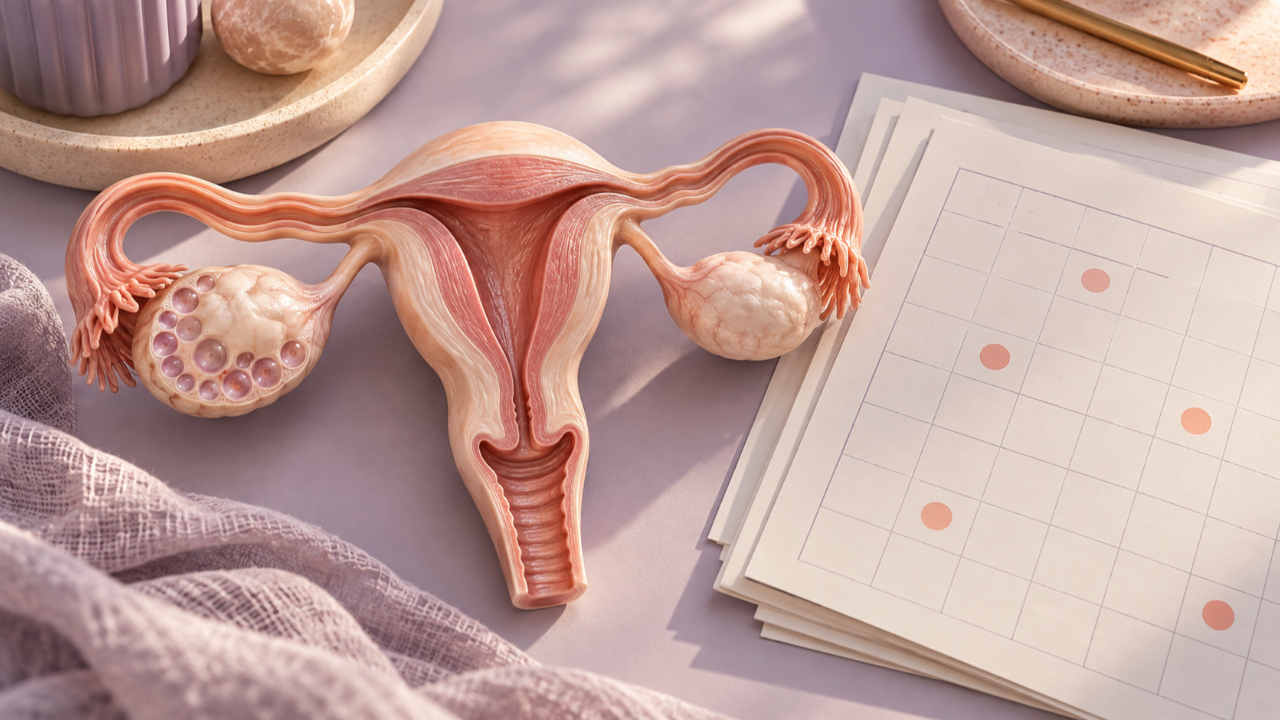
How Long Does It Take to Get Pregnant With PCOS?
If you have polycystic ovary syndrome (PCOS) and you are trying to conceive, you have probably asked the question that matters most: how long is this going to take? It is a fair thing to wonder, especially when every month feels like a long wait.
Here is the short answer. There is no single timeline, but most women with PCOS do get pregnant. It often takes longer than average, and the difference usually comes down to one thing: how regularly you ovulate. This guide breaks down what to expect, what can speed things up, and when it is time to get support.
How Long Does It Take to Get Pregnant With PCOS?
For context, about 80 to 85 percent of couples in the general population conceive within 12 months of trying, and a healthy couple has roughly a 20 percent chance of pregnancy in any single cycle.
With PCOS, your chance in a given month depends on whether you ovulate that month. If you ovulate regularly, your timeline may look close to anyone else’s. If you ovulate rarely or not at all, you may have only a few fertile cycles a year, so it can take many months, or longer, without help.
In real life, that means a range:
- Some women with PCOS conceive within a few months, especially when ovulation is only mildly irregular.
- Others need 6 to 12 months or more of tracking and lifestyle changes.
- Many women conceive within the first few cycles of ovulation inducing medication once ovulation is restored.
- Some need further treatment such as injectable medications or IVF.
PCOS affects roughly 8 to 13 percent of women of reproductive age, and it is one of the most common causes of ovulation problems. Being in that group does not close the door. It simply changes the route. If you want a deeper overview, read our guide on PCOS and fertility: can you still get pregnant.
Why Does PCOS Make It Take Longer?
Pregnancy requires a mature egg to be released, and in PCOS that release is often delayed or skipped. Several things contribute:
Hormone imbalance. Many women with PCOS have higher levels of androgens (sometimes called male hormones) and, often, elevated LH. This can interfere with how follicles develop and mature.
Insulin resistance. Many women with PCOS, including some who are not overweight, have insulin resistance. Higher insulin levels can push the ovaries to make more androgens and can disrupt ovulation.
Irregular cycles. When your cycles are long or unpredictable, you have fewer chances to conceive each year, and it is hard to know when your fertile window is. Cycles longer than 35 days, or fewer than 8 periods in a year, are commonly used as signs of irregular ovulation.
The encouraging part is that each of these can be addressed. Ovulation is often reversible with the right mix of lifestyle support and, when needed, medication.
Can You Get Pregnant With PCOS Naturally?
Yes, many women do. If you ovulate even occasionally, natural conception is possible. PCOS does not mean you cannot ovulate. It means ovulation may be less predictable.
The challenge is catching it. Our article on trying to conceive with PCOS goes into practical steps, and the tracking section below will help you know when your body is actually ready.
What Affects How Long It Takes?
Your personal timeline depends on more than your PCOS diagnosis. Key factors include:
How often you ovulate. This is the biggest driver. More ovulatory cycles means more chances.
Your age. Egg quantity and quality decline with age, which affects every woman regardless of PCOS. If you are 35 or older, time matters more.
Your metabolic health. Insulin resistance, weight, and blood sugar regulation all influence ovulation.
Your partner’s sperm health. In about half of couples who have trouble conceiving, a male factor is involved. A semen analysis is one of the quickest tests you can do, and our guide on male infertility causes, tests, and treatment explains what to expect.
Your fallopian tubes and uterus. Even if ovulation is restored, blocked tubes or uterine issues can slow things down.
Other conditions. Thyroid problems and high prolactin can mimic or worsen PCOS symptoms, so they are worth ruling out.
How Can You Speed Things Up?
You cannot force ovulation, but you can create conditions that support it. Here is where to focus.
Support your metabolism. For women who carry extra weight, losing even 5 to 10 percent of body weight can help restore ovulation. If weight is not an issue for you, the focus is on blood sugar balance rather than the scale. Build meals around protein, fiber, healthy fats, and slow digesting carbohydrates. Our fertility nutrition guide shows you how.
Move in a way that helps, not hurts. Regular strength training and walking improve insulin sensitivity. Very intense, frequent workouts can add stress to your body, so more is not always better. You may relate to why Katy stopped doing high intensity workouts.
Protect your sleep and manage stress. Poor sleep and chronic stress can affect hormones and blood sugar, both of which matter in PCOS.
Start folic acid now. Experts recommend at least 400 micrograms daily before you conceive. Beyond that, ask your provider which supplements make sense for you. Some studies suggest inositol may help with ovulation and insulin sensitivity in PCOS, though the evidence is mixed. Our guides to the best fertility supplements and natural ovulation supplements explain what the research does and does not support.
Give changes time. Eggs take roughly three months to mature, so many providers suggest giving lifestyle changes about 3 to 6 months to show results. Read more in how long it takes to improve fertility naturally.
What Medical Treatments Can Help?
If lifestyle changes are not enough, or if you want to move faster, medical treatment can make a big difference.
Letrozole. This is generally considered the first line medication for ovulation induction in PCOS, and it is often used off label for this purpose. In a large clinical trial, letrozole led to more live births than clomiphene, about 27.5 percent compared with 19.1 percent over up to five treatment cycles. Many providers try it for about 3 to 6 cycles with ovulation monitoring.
Clomiphene and metformin. Clomiphene is another oral option. Metformin may help women with insulin resistance and is sometimes combined with other treatments.
Injectable medications. If oral medications do not work, injectable hormones (gonadotropins) can stimulate follicle growth, with closer monitoring to lower the risk of multiple pregnancy.
IVF. IVF may be recommended if other treatments fail, or if there are other factors such as tubal problems, male factor infertility, or older age. Women with PCOS often produce many eggs, so protocols are adjusted to reduce the risk of ovarian hyperstimulation syndrome.
Your provider will help match the treatment to your age, test results, and goals.
How to Track Ovulation With PCOS
Tracking can feel confusing when your cycles are irregular, but it can save you months of guessing. A few tips:
Use more than one method. Ovulation predictor kits can give false positives in PCOS because LH is often already elevated. Pairing them with cervical mucus and basal body temperature gives you a clearer picture.
Use BBT to confirm, not predict. A sustained temperature rise confirms that ovulation happened. Learn the method in our guide on how to take your basal body temperature correctly, and see what charts can show in our post on the basal body temperature chart for pregnant vs not pregnant cycles.
Know the signs. Stretchy, clear cervical mucus and other body clues can point to ovulation. See our list of the signs of ovulation.
Test at the right time. If you suspect pregnancy, check our guide on when to take a pregnancy test so you do not test too early.
When Should You See a Provider?
With PCOS, you do not need to wait the standard 12 months. Reach out sooner if you:
- Have very irregular or absent periods
- Have been trying for 6 months and are 35 or older
- Are 40 or older
- Have not had a period in three months
- Have a history of pelvic infections, endometriosis, or tubal problems
Early support saves time and stress. Our guide on when to get fertility testing helps you decide, and our post on being not pregnant after 6 months explains why waiting is not always the best choice. You can also review 5 things to check first when you are struggling to get pregnant.
It is also wise to get preconception care. PCOS is linked with a higher chance of gestational diabetes and high blood pressure in pregnancy, so having your health reviewed before you conceive helps protect both you and your baby.
Frequently Asked Questions About Getting Pregnant With PCOS
Can you get pregnant with PCOS without medication?
Yes. If you ovulate, even irregularly, pregnancy is possible without medication. Lifestyle changes, ovulation tracking, and good timing help many women conceive naturally.
How long should I try before seeing a doctor if I have PCOS?
You do not need to wait a full year. If your periods are irregular or absent, it is reasonable to seek help right away. If your cycles are regular, the usual guidance of 12 months applies, or 6 months if you are 35 or older.
Does losing weight help you get pregnant with PCOS?
For women who carry extra weight, losing 5 to 10 percent of body weight can improve ovulation and increase the chance of pregnancy. If weight is not a concern, focusing on blood sugar balance, sleep, and stress is more helpful than weight loss.
Is it harder to get pregnant with PCOS at 35 or older?
Age affects fertility for everyone, and PCOS can add ovulation challenges on top of that. The sooner you seek guidance after 35, the more options you have, so there is a good reason to start early.
Can you get pregnant with PCOS if you have no periods?
It is harder because no periods often means no ovulation, but pregnancy is still possible with treatment. Ovulation induction medication can restore ovulation in many women, and an ovulation can occur before a first period, so contraception matters if you are not trying to conceive.
Does PCOS get worse the longer you wait?
PCOS itself does not necessarily worsen, but age related changes to egg quality and quantity continue. Starting a plan sooner gives you more time and more choices.
Take the Next Step
Getting pregnant with PCOS can take longer, but a clear plan makes a real difference. When you understand how your cycle works, what your labs mean, and which support fits your body, you stop guessing and start moving forward.
If you want personalized guidance, Katy Poole, a fertility consultant and nurse practitioner, offers one on one fertility consulting services to help you understand your hormones, ovulation, and next steps. You can also explore the Get Pregnant Faster program or browse more fertility health resources.