
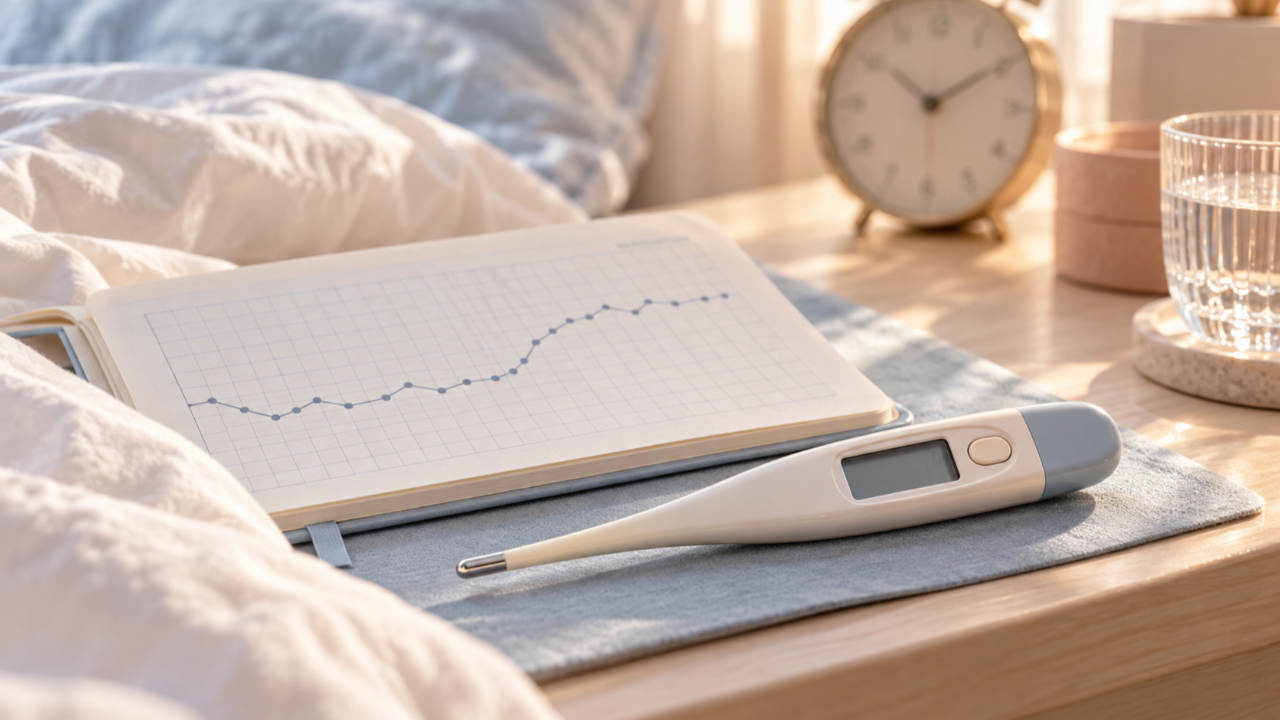
Basal Body Temperature to Get Pregnant: What Your BBT Should Be
If you are tracking your cycle, you have probably stared at a chart and wondered whether those little ups and downs mean something. They do, but not always what people think. Your basal body temperature (BBT) is a useful tool, and it is also one of the most misunderstood.
This guide explains what your BBT should look like when you are trying to conceive, what it can and cannot tell you about your fertile window, and what to expect around implantation and early pregnancy.
What Is Basal Body Temperature and Why Does It Matter?
Basal body temperature is your lowest resting body temperature, measured first thing in the morning before you get out of bed, talk, or drink anything. It moves in a predictable pattern across your cycle because of your hormones.
In the first half of your cycle, before ovulation, estrogen dominates and your temperature stays relatively low. After you ovulate, your body produces progesterone, which raises your resting temperature slightly. That is why a healthy, ovulatory cycle shows two phases on a chart: a lower phase followed by a higher phase. Doctors call this a biphasic pattern.
Here is the most important thing to understand from the start: BBT confirms ovulation after it has happened. It does not predict it. A rise tells you that ovulation likely occurred in the last day or two, which means your most fertile days may already be behind you. To time intercourse well, BBT works best alongside other tools such as ovulation tests and cervical mucus. You can read more about those in our guide to the signs of ovulation and when you are most fertile.
What Should Your Basal Temperature Be to Get Pregnant?
There is no single magic number you need to hit to get pregnant. What matters is the pattern, not one reading.
As a general guide, many women see a temperature of about 97.0 to 97.7 degrees Fahrenheit (36.1 to 36.5 degrees Celsius) before ovulation. After ovulation, temperatures typically rise by roughly 0.4 to 1.0 degrees Fahrenheit (0.2 to 0.6 degrees Celsius), landing around 97.8 to 99.0 degrees Fahrenheit (36.6 to 37.2 degrees Celsius). Your own numbers may sit higher or lower than this range, and that is completely normal. Thermometers also differ, so your baseline matters more than any textbook figure.
What you want to see is:
- A clear, sustained rise after the first half of your cycle
- Temperatures that stay elevated for about 10 to 16 days after ovulation
- A pattern that repeats from cycle to cycle
If your temperatures stay flat all month with no clear rise, you may not be ovulating that cycle. If your high phase is very short, it could be worth asking your provider to look at your progesterone. Neither one is a diagnosis, but both are good reasons to have a conversation. Our guide on when to get fertility testing can help you decide what to do next.
To get readings you can trust, take your temperature at the same time every morning with a BBT thermometer that reads to two decimal places, after at least three to four hours of sleep. Our walkthrough on how to take your basal body temperature correctly covers the details.
What Is the 3 Over 6 Rule in BBT?
The 3 over 6 rule is a simple way to confirm that a real temperature shift has happened, so you are not fooled by a single warm morning.
Here is how it works. Look at the six temperatures before the suspected rise and find the highest one. A true shift is confirmed when three days in a row are higher than that highest temperature, and the third of those three days is at least 0.2 degrees Fahrenheit (0.1 degrees Celsius) above it. The line you draw just above that highest pre shift temperature is often called the coverline.
For example, if your highest temperature in the six days before the rise was 97.5, you would look for three consecutive readings above 97.5, with the third at 97.7 or higher. Once that happens, ovulation is considered confirmed.
Remember that the rule works in hindsight. By the time the third high temperature appears, your fertile window has usually closed. Its real value is in showing you whether you ovulate, when you tend to ovulate, and how long your luteal phase lasts. That information helps you time future cycles. If your cycles are irregular and the rule rarely gives a clear answer, our article on trying to conceive with PCOS may be useful.
Am I Fertile 2 to 3 Days Before My Period?
In most cases, no. Pregnancy two to three days before your period is very unlikely.
Here is why. Ovulation typically happens about 10 to 16 days before your next period begins, with 12 to 14 days being most common. After ovulation, the egg survives only about 12 to 24 hours. By two or three days before your period, you are deep in the luteal phase, the egg is long gone, and your progesterone is preparing to drop. Sperm can survive for up to five days in the reproductive tract, but that only helps when intercourse happens before ovulation, not after.
Your fertile window is the roughly six days ending on the day of ovulation, with the two days before ovulation being the most fertile. This is why timing intercourse in the days leading up to a temperature rise gives you better odds than waiting for the rise itself.
There are a few reasons the answer can feel less clear than it sounds:
- Irregular cycles. If your cycle length varies widely, it can be hard to know when your period is actually due.
- Mid cycle bleeding. Spotting around ovulation can be mistaken for a period.
- Late ovulation. If you ovulated later than usual, your period may be later than you expected.
Your BBT chart is the best way to cut through the guesswork, because it shows you when ovulation really happened. You may also find our post on whether you can get pregnant right after your period helpful, since it covers the opposite end of the cycle.
What Is the Ideal Basal Temperature for Implantation?
There is no ideal implantation temperature, and any source that gives you one exact number is overstating what the research shows.
What we do know is the timing. Implantation usually happens about 6 to 12 days after ovulation, most often around 8 to 10 days. For implantation to be possible at all, your temperature should be in its high phase, which means you have ovulated and your progesterone is doing its job. Staying above your coverline is the real goal.
You may have seen mention of an implantation dip, a single day when the temperature drops by a small amount and then rises again around 7 to 10 days after ovulation. Some women who go on to become pregnant see this on their charts. Many do not, and plenty of women who are not pregnant see similar dips for other reasons. Because it is so unreliable, please do not use a dip, or the lack of one, to predict your outcome. A dip does not mean you are pregnant, and no dip does not mean you are not.
What Should My Temperature Be If I Conceived?
If you conceived, your temperature does not jump to a special number. It simply stays high.
In a cycle without pregnancy, progesterone falls near the end of the luteal phase and your temperature drops a day or two before your period starts. In a cycle with pregnancy, your body keeps producing progesterone, so your temperature stays elevated instead of falling. If your temperatures remain high for 18 or more days after ovulation, pregnancy is very likely, and it is time to take a test.
Some charts show a second small rise about a week after ovulation, called a triphasic pattern. It is sometimes talked about as a sign of pregnancy, but it is not a reliable one, so treat it as interesting rather than conclusive.
Two cautions are important here. First, a high temperature on its own is not a pregnancy test. Illness, poor sleep, alcohol, and stress can all raise or scramble your readings. Second, a fever of 100.4 degrees Fahrenheit (38 degrees Celsius) or higher is not something to chart and wait out. Contact your healthcare provider. For the best accuracy on testing, see our guide on when to take a pregnancy test, and to compare charts side by side, read our breakdown of the basal body temperature chart for pregnant vs not pregnant cycles.
What Can Throw Off Your BBT Readings?
BBT is sensitive, which is both its strength and its weakness. These common factors can skew a reading:
- Less than three to four hours of uninterrupted sleep
- Taking your temperature at a different time than usual
- Alcohol the night before
- Illness, fever, or infection
- Travel and time zone changes
- Certain medications
- A very warm or cold bedroom, or changing from an oral to a vaginal reading mid cycle
One off reading is rarely a problem. Look at the overall trend and mark unusual days on your chart so you can read it with context.
When to Talk to a Provider
BBT charting is helpful, but it is not a diagnostic test. Reach out to a provider if you notice no temperature rise across several cycles, a luteal phase shorter than 10 days, very irregular cycles, or if you have been trying without success for 12 months, or 6 months if you are 35 or older. Our post on being not pregnant after 6 months explains why waiting longer is not always the best choice, and 5 things to check first when you are struggling to get pregnant gives you a clear starting point.
Frequently Asked Questions About Basal Body Temperature
Does BBT tell me the best day to have sex?
Not directly. Because your temperature rises after ovulation, it shows you when your fertile window has likely passed. Over several cycles, though, your chart reveals when you usually ovulate, which helps you time intercourse in future cycles. Pairing BBT with ovulation tests gives you a better real time view.
What time of day should I take my basal body temperature?
Take it at the same time every morning, ideally right after waking and before you get out of bed, sit up, or drink anything. A few minutes of difference will not ruin your chart, but an hour or two can shift your readings.
Can I still get pregnant if my temperature does not rise?
If your temperature never rises, you may not have ovulated that cycle, which makes pregnancy that month unlikely. Occasionally the rise is too subtle to see, or a thermometer, sleep issue, or illness hides it. If this happens often, talk to a provider.
Can BBT confirm pregnancy before a test?
BBT can offer a clue, since temperatures that stay high for 18 or more days after ovulation suggest pregnancy. It cannot confirm it. A home pregnancy test or a blood test is the way to be sure.
Is a low basal body temperature bad for fertility?
Not necessarily. Your personal baseline matters more than a universal number. What counts is whether you see a clear rise after ovulation and whether it holds. If your high phase looks weak or short, it is worth asking your provider about progesterone.
Do I need to track BBT if I use ovulation tests?
No. Ovulation tests help you predict your fertile window, while BBT confirms that ovulation took place. Using both gives you the most complete picture, but you can choose the method that fits your life. And if you are trying to conceive, remember that fertility is a two person effort, so it is worth reading about male infertility causes, tests, and treatment too.
Take the Next Step
Your BBT chart is one piece of a bigger fertility picture. It can reveal whether you ovulate, how long your luteal phase lasts, and when pregnancy may be possible, but it works best with the right context and support.
If you want help reading your charts and building a plan for your body, Katy Poole, a fertility consultant and nurse practitioner, offers personalized fertility consulting services for women and couples. You can also explore the Get Pregnant Faster program to understand your cycle, hormones, and labs, or browse more fertility health resources.